Key Takeaways
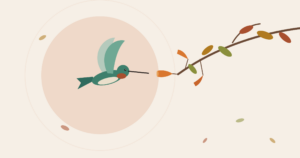
- Being present involves appreciating simple moments, like a hummingbird in your path, fostering gratitude for ordinary things.
- Mindfulness means paying attention to the current moment without judgment, allowing us to escape preoccupation with the past or future.
- You can practice mindfulness in daily life through techniques like breath anchors, one-task rules, and sensory pauses.
- Research shows mindfulness decreases stress and improves emotional regulation, leading to clear thinking and better responses.
- Incorporate mindfulness into daily routines with simple practices, focusing on small, intentional actions instead of perfection.
Estimated reading time: 6 minutes
What Two Hummingbirds Taught Me
I used to be one of those people who would jump from task to task, never stopping to “smell the roses,” as the saying goes. Sometimes, I still am.
But there was a moment that stopped me long enough to be present. And it was so ordinary.
One day I was walking, and a hummingbird appeared on my right side. Then a second one came to my left. As I continued walking, the birds flew next to me for quite a while.
In that moment, I realized I was not being grateful for the simple, everyday, ordinary things. It truly made me pause and look at life, and my actions, differently. It opened my eyes not only to the wonders of the world, but to gratitude — to be grateful for the little things, because sometimes they are the best things.
That’s mindfulness. Not some grand achievement. Just two hummingbirds and the willingness to actually notice them.
Understanding Mindfulness
Mindfulness gets used as a buzzword a lot these days, but it’s simpler than the wellness industry makes it sound.
Jon Kabat-Zinn, founder of the Mindfulness-Based Stress Reduction (MBSR) program at UMass Medical School, defines it as: paying attention, on purpose, in the present moment, without judgment.
That’s it. Not clearing your mind. Not achieving some blissed-out state. Just noticing what’s actually happening, right now, without immediately labeling it good or bad.
Most of us live somewhere else entirely, replaying yesterday or rehearsing tomorrow, and missing the only moment we actually have any power in: this one. Harvard researchers Matthew Killingsworth and Daniel Gilbert found our minds wander nearly half the time, and we’re less happy when they do.
Try this: Right now, notice three things you can see, two things you can hear, one thing you can feel. That’s mindfulness. It’s not complicated. It’s a muscle we can build.
Mindfulness Techniques for Everyday Use
You don’t need a cushion, a retreat, or 30 silent minutes to practice this (although a good meditation is beneficial). Small, woven-in moments work just as well.
- Breath anchor: Take three slow breaths before opening your laptop, phone, or car door to reconnect with yourself.
- One-task rule: Eat without your phone, drive without the radio, fold laundry without a podcast, just for one task a day to focus on the task at hand.
- Body scan check-in: 60 seconds noticing where you’re holding tension (shoulders, jaw, hands). If you notice tension, shake it out.
- Naming practice: Silently name what you’re feeling (“this is frustration,” “this is excitement”) instead of just being swept into it. Naming it can decrease stress.
- Sensory pause: Mid-task, stop and notice one thing you can touch, smell, or hear. How does it make you feel?
Try this: Pick just one of these and do it before or after something you already do daily (brushing teeth, starting the car, sitting down at your desk). Tiny steps can make a big difference. Repetition builds a habit, not willpower.
Benefits of Mindfulness in Reducing Stress
This isn’t just a feel-good practice, it’s backed by real research.
- A landmark Harvard study led by neuroscientist Sara Lazar found that consistent mindfulness practice reduced gray matter density in the amygdala, the brain’s alarm system, which tracked with lower stress levels.
- Kabat-Zinn’s original MBSR research showed significant reductions in stress and pain-related symptoms in patients after just eight weeks of practice.
- A 2010 meta-analysis published in the APA’s Journal of Consulting and Clinical Psychology, reviewing 39 studies and over 1,100 participants, found mindfulness-based therapy meaningfully reduced both anxiety and depressive symptoms, with even stronger effects in people diagnosed with anxiety or mood disorders.
Here’s why that matters: stress isn’t just a feeling, it’s a physiological state. When you’re mindful, you shift out of the reactive fight-or-flight response and into a state where you can actually think clearly and choose your response. That’s your nervous system working the way it was designed to.
Incorporating Mindfulness Into Your Daily Life
The goal isn’t to add mindfulness as one more thing on your to-do list. It’s to weave it into what you’re already doing.
Try this:
- Morning: Before checking your phone, take five conscious breaths and set one intention for the day
- Midday: Set a phone reminder for one “pause point,” even 30 seconds counts
- Evening: Name one moment from the day you were fully present for, no matter how small. Or be grateful for one thing that happened today.
Like every mindset shift I write about here, this isn’t about perfection. It’s about the small, repeated choice to come back to the present moment, again and again, every time you notice you’ve drifted.
Final Thought
You don’t need to master mindfulness. You just need to practice returning, again and again, to right now.
That’s the whole practice. And the more you return, the more natural it becomes.
For more inspiration, take a look at Wake Up! Change Up! Rise Up!. Chapter six, Be Present in Ordinary Moments, gives tips on how to be more present, and chapter seven, Be Still, provides mindfulness techniques on breathing, meditation, meditative movements, and medTEAtion.
Speak Kindly. Rise Boldly.
Lynn
A: Yes. While many studies used structured 8-week programs, even brief daily practices can help you build the habit. Consistency matters more than duration.
A: Meditation is a formal practice, usually a set time, often sitting still. Mindfulness is the skill itself: paying attention, on purpose, without judgment. You can be mindful while walking, eating, or (like me) simply noticing two hummingbirds beside you. Meditation builds the muscle; mindfulness is using it throughout your day.
A: That’s normal, not failure. Noticing that your mind wandered is the mindfulness. Gently bring your attention back, without judging yourself for drifting. That return, over and over, is the actual practice, not a sign you’re doing it wrong.
Source: Killingsworth, M. A., & Gilbert, D. T. (2010). A wandering mind is an unhappy mind. Science, 330(6006), 932. https://doi.org/10.1126/science.1192439
Read here: https://lynnlokpayne.com/the-present-moment-is-a-gift/